Verified maturity of cybersecurity management
Hikvision has officially confirmed compliance with NIST Cybersecurity Framework (CSF) 2.0 following an independent audit conducted by the British Standards Institution (BSI). This places Hikvision among the first companies worldwide to demonstrate alignment with the latest version of this globally recognised cybersecurity management framework.
It is important to be precise here. This is not a marketing declaration and it is not a product-level badge. The certification confirms that Hikvision’s organisational approach to cybersecurity, risk management and governance has been independently assessed against the NIST CSF 2.0 structure.
BOIT is an authorised Hikvision partner and delivers CCTV systems based on this ecosystem, covering system design, secure deployment, hardening and long-term operational support.
What is NIST CSF 2.0?
The NIST Cybersecurity Framework was developed by the National Institute of Standards and Technology as a practical model for managing cybersecurity risk. Version 2.0, released in 2024, significantly strengthens the role of governance and supply chain risk management, shifting cybersecurity from a purely technical discipline to an organisational responsibility.
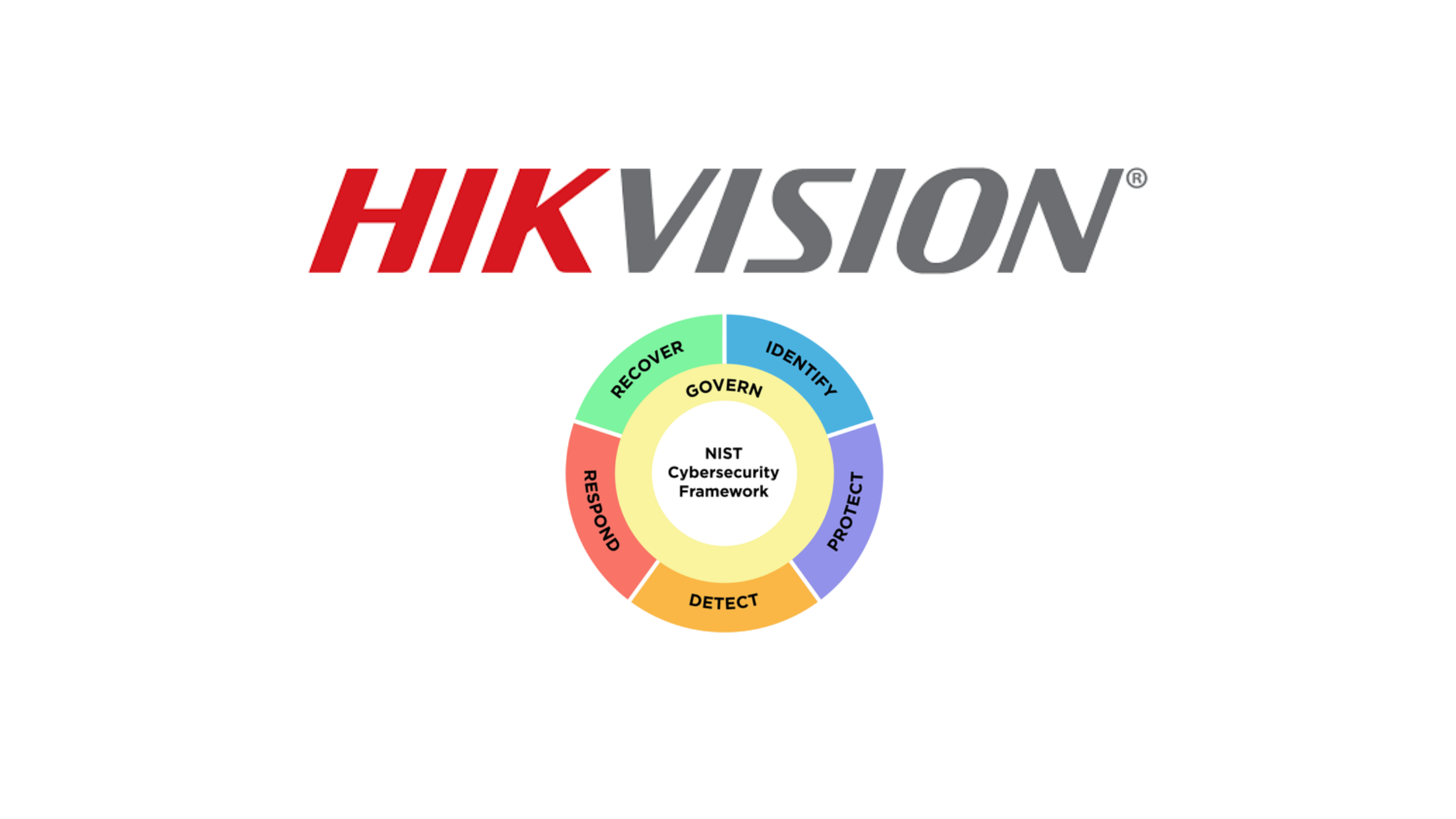
NIST CSF 2.0 is structured around six core functions:
- Govern
- Identify
- Protect
- Detect
- Respond
- Recover
Together, they form a continuous lifecycle for managing cyber risk across technology, people and processes.
What exactly was assessed during the Hikvision audit?
NIST CSF 2.0 certification does not involve testing individual cameras, recorders or firmware versions. Instead, the audit focuses on how cybersecurity is managed across the entire organisation.
In practice, the following areas are evaluated.
Governance and accountability
The audit verifies whether cybersecurity responsibilities are formally defined, how risk decisions are taken at management level, and how cybersecurity is integrated into overall business strategy. A key element is supply chain risk management, including oversight of third-party components, software libraries and external dependencies.
Asset and risk identification
This includes maintaining structured inventories of systems and components, classifying their criticality, and analysing dependencies between hardware, firmware, software and network services. Without this visibility, effective vulnerability and update management is not possible.
Protection mechanisms
Auditors assess whether security principles such as secure-by-design and secure-by-default are embedded in product development. This also covers access control models, configuration standards, firmware update processes and data protection mechanisms.
Detection capabilities
The organisation must demonstrate the ability to log security-relevant events, monitor system behaviour and detect anomalies that could indicate misuse or compromise.
Incident response
A mature and tested incident response process is required, including vulnerability handling, internal escalation paths and external communication procedures when security issues arise.
Recovery and resilience
The audit also examines how services are restored after incidents, how recovery processes are tested and how lessons learned are incorporated into continuous improvement.
Hikvision’s official cybersecurity framework and transparency
Hikvision publicly documents its cybersecurity approach in the dedicated Cybersecurity section of its support portal. This includes:
- published security advisories,
- documented best practices for system configuration and deployment,
- white papers describing security architecture and processes,
- transparency regarding standards and certifications adopted by the company.
This material confirms that cybersecurity is treated as an ongoing process rather than a one-time compliance exercise.
Additional standards and certifications
In addition to NIST CSF 2.0, Hikvision reports compliance with multiple internationally recognised standards, including ISO/IEC 27001, ISO/IEC 27701, ISO/IEC 27017 and ISO 38505-1. NIST CSF does not replace these standards, but provides a unifying framework that links governance, risk and technical controls into a coherent model.
What does this mean for real-world CCTV projects?
Modern CCTV systems are no longer isolated video devices. They consist of IP-based cameras, recorders, management software, mobile applications, directory integrations and remote access mechanisms.
From an operator or investor perspective, NIST CSF 2.0 certification indicates that the manufacturer:
- maintains structured and auditable security processes,
- manages vulnerabilities and updates in a predictable manner,
- formally addresses supply chain and third-party risk,
- supports integration into regulated environments and audit-driven organisations.
This is particularly relevant in sectors subject to regulatory oversight, internal audits or security frameworks such as ISO 27001 or NIS2.
How BOIT applies this in practice
As an authorised Hikvision partner, BOIT designs and deploys CCTV systems with security as a core requirement. In practice this includes:
- network architectures with dedicated CCTV segmentation,
- controlled routing and firewall policies,
- restricted administrative access and clear role separation,
- structured firmware and configuration management,
- monitoring, logging and defined incident response procedures,
- backup and recovery planning for critical system components.
This approach ensures that CCTV systems are not only functional, but also operationally secure and auditable.
Conclusion
NIST CSF 2.0 certification confirms that Hikvision approaches cybersecurity as a managed, organisation-wide process rather than a feature of individual products. For organisations treating CCTV as part of their critical infrastructure, this provides a more reliable foundation for long-term operation, compliance and risk management.