Migrating from VMware to Proxmox: Analysis Using the Tesco Example
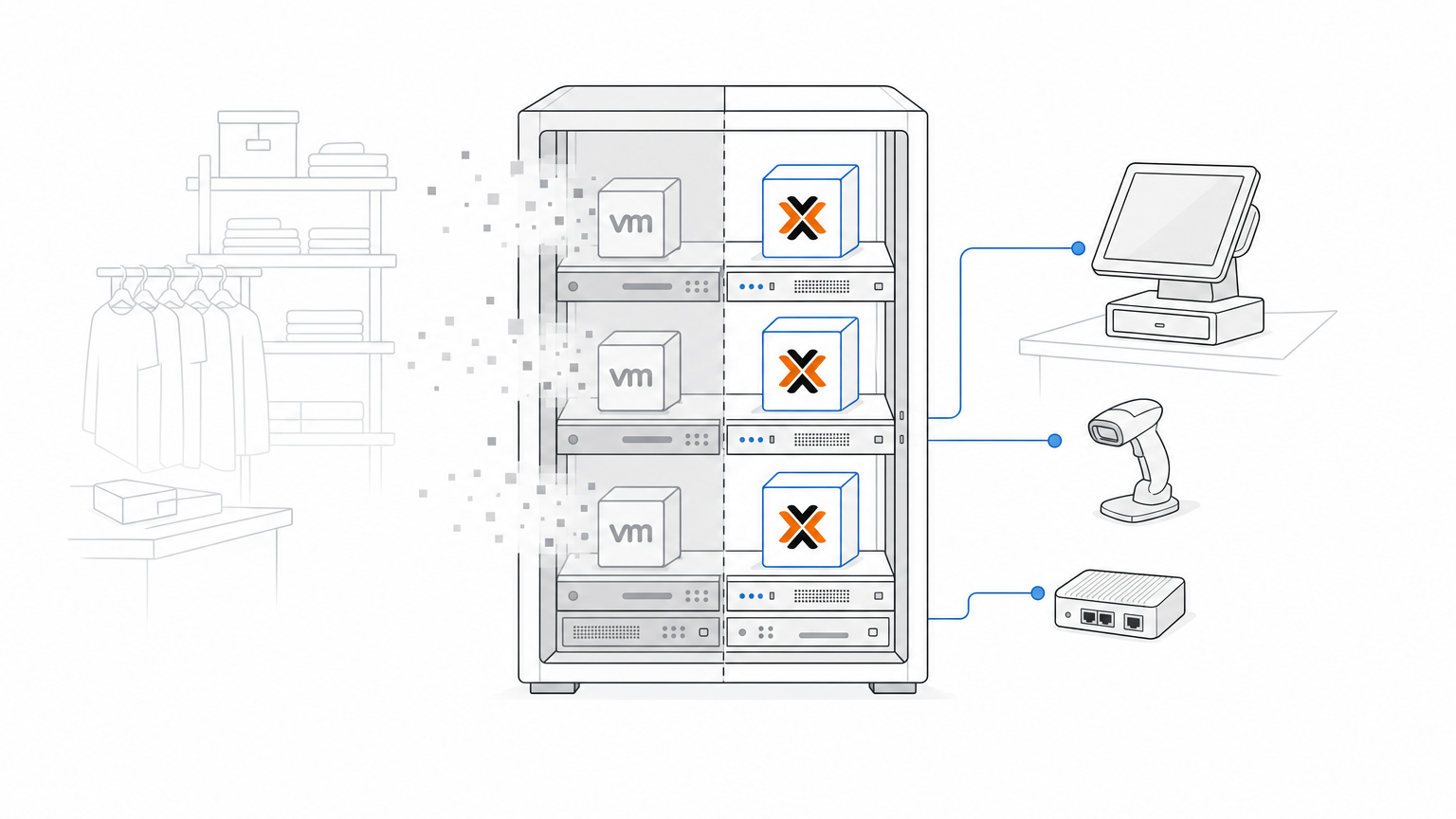
Proxmox Instead of VMware? What Tesco’s Plans Mean for Businesses Considering Migration
Switching virtualization platforms can reduce costs and give businesses greater flexibility. Before making the move, organizations need to assess application compatibility, backup and recovery, support, and day-to-day administration. Tesco’s reported plans to migrate from VMware to Proxmox bring these questions into focus.
In an article published on 26 October 2026, The Register describes a Tesco job advertisement for a leadership role responsible for its edge platform. The responsibilities include migrating from VMware to Proxmox and developing a platform to manage infrastructure across stores. This indicates a planned direction, while the full scope, implementation details, and measured results remain undisclosed.
For businesses in Poland and elsewhere, this is an opportunity to review their own infrastructure. Does the current platform still meet operational needs? What is its total cost? Could an alternative provide the required availability and support?
Why Consider Proxmox?
Proxmox Virtual Environment is an open-source platform that combines KVM virtualization, LXC containers, and management of compute, networking, and storage resources. Its web interface supports virtual machine and cluster administration, including high availability configurations.
When evaluating a move from VMware, businesses should consider:
- Total cost of ownership. Include subscriptions, support, backups, hardware, administration, training, and the migration itself.
- Dependence on suppliers. An open-source platform can provide greater flexibility, although configuration, integrations, and specialist knowledge still create dependencies.
- Operational requirements. Compare the features actually used in production and how the new platform would deliver them.
- Maintenance responsibilities. Define who will handle updates, monitoring, incidents, and escalation to technical support.
Potential savings should be assessed over several years. Lower software costs may be offset by integration work, additional administration, or an infrastructure design that is difficult to maintain.
Open Source with Commercial Support
Choosing Proxmox does not mean relying solely on an internal team or community forums. The vendor offers paid subscriptions that provide access to the Enterprise Repository and technical support. Coverage and initial response times depend on the selected plan.
Support arrangements should match business operating hours and the importance of each service. A guaranteed initial response time is different from a guaranteed service restoration time. Organizations also need recovery procedures and clear responsibility for putting them into action.
What Should You Check Before Migrating?
A migration decision should be based on application requirements and business processes. The assessment should cover:
- Application and operating system compatibility: vendor support policies, licensing conditions, drivers, and dependencies on physical devices.
- Networking and storage: VLANs, firewall rules, storage performance, redundancy, and connections between sites.
- Backup and recovery: tool compatibility, application-consistent backups, and the ability to restore services within the required time.
- Availability: acceptable downtime and acceptable data loss.
- Security: restricted administrative access, multifactor authentication, permissions, and logging.
- Operations: monitoring, updates, documentation, and administrator training.
Starting a virtual machine successfully after migration is only one part of validation. Testing should also confirm application functionality, performance, communication with other systems, and recovery from backups.
Managing Multiple Locations
Infrastructure in stores, branch offices, and production facilities must account for local hardware limitations, connection quality, and access to technical staff. The design should also define how services behave when connectivity to headquarters is lost.
The Proxmox ecosystem includes Proxmox Datacenter Manager, which provides centralized visibility and management across multiple nodes and clusters. Organizations can therefore evaluate a central management approach for distributed environments.
Before deployment, verify the capabilities available in the selected version, integration requirements, and any additional automation needed. Central management should support tested procedures for updates, monitoring, and incident response.
How to Prepare for a VMware-to-Proxmox Migration
A structured migration can be divided into six stages:
- Inventory and dependency mapping. Identify virtual machines, applications, databases, and network connections. Establish the order in which services can be moved.
- Target environment design. Plan compute capacity, networking, storage, backups, and availability requirements.
- Pilot migration. Move representative workloads and test them under conditions that reflect production.
- Recovery testing and rollback planning. Verify backups and define when and how to reverse the migration, including how to handle data written after the switchover.
- Phased rollout. Schedule maintenance windows, communicate with users, and validate services after each stage.
- Stabilization and operational handover. Monitor performance, update documentation, and prepare the team to maintain the new environment.
Do not assume that migration between platforms will be possible without downtime. The migration method and acceptable service interruption should be established for each workload and confirmed during testing.
Is Proxmox the Right Choice for Your Business?
Proxmox is worth evaluating when modernizing infrastructure, expanding capacity, or reviewing virtualization costs. The decision should be guided by test results, application compatibility, availability requirements, and the capabilities of the IT team.
For some organizations, a full migration may be appropriate. Others may benefit from moving selected workloads gradually or retaining part of their existing environment. The approach should reflect the needs of the business and the evidence gathered during assessment.
How BOIT Can Help
BOIT helps businesses assess their infrastructure, prepare migration plans, and test the transition to a new virtualization platform. We help identify system dependencies, plan administrative access segmentation, and implement independent backups.
Considering a move from VMware to Proxmox? Contact BOIT at biuro@boit.pl. Together, we can assess the options, costs, and risks for your environment.
Sources and Further Reading
- The Register: Tesco replacing VMware with Proxmox in its stores and on the edge, 26 October 2026.
- Proxmox Virtual Environment: platform overview.
- Proxmox VE: subscriptions and support.
- Proxmox Datacenter Manager: centralized infrastructure management.
